
The GCSE Revision Diary Planner: What's Inside, How It Works, and Why Structure Changes Everything
Revision Tools

Your child's exams are getting closer, the revision is still not really happening, and you are wondering whether buying a GCSE revision diary planner will make any actual difference. That is a fair question. The honest answer: a planner does not do the revision for anyone. What it does is remove the single biggest barrier to starting… not knowing where to begin.
This is exactly why we built one. Our own daughter reached GCSE age with bits of information from every subject teacher, sheets and half-finished revision ideas loose in her bag, no home for any of it. Twenty-two years of watching the same thing happen in GCSE classrooms had already taught us how to deal with it. Going through it with her at the kitchen table, and documenting the process as we went, is what actually became the GCSE Revision Diary Planner.
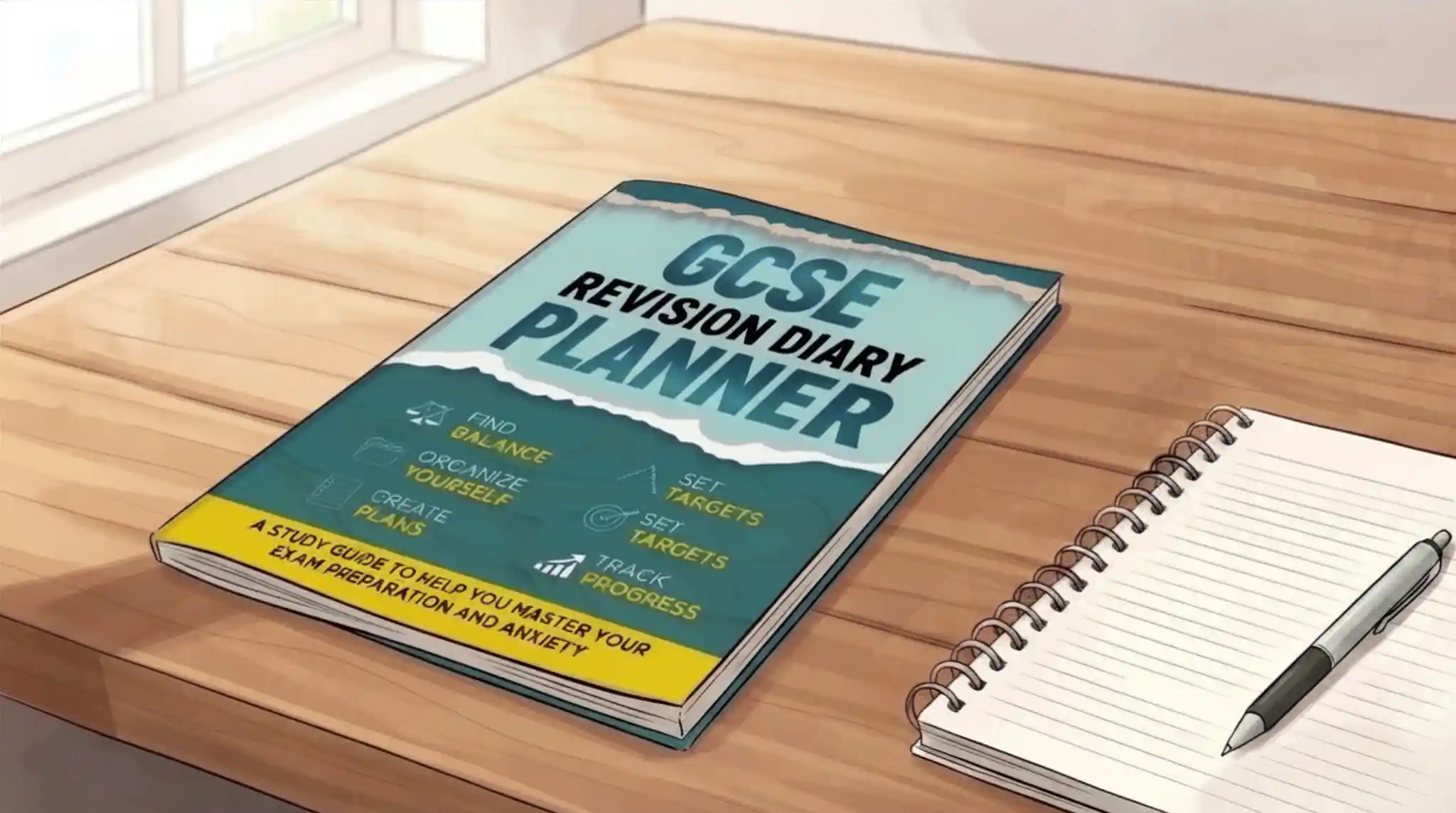
Quick Answer: Is the GCSE Revision Diary Planner Worth It?
The GCSE Revision Diary Planner is a 116-page paperback covering four months of weekly and daily revision timetables, built around a topic-by-topic confidence audit, mock exam analysis, and specific revision techniques (interleaving, retrieval practice, spaced repetition) rather than blank timetable grids alone. It suits a student who has the time to revise but no idea what to do with it, more than a student who already has a working system.
Inside the Planner, Page by Page
- •
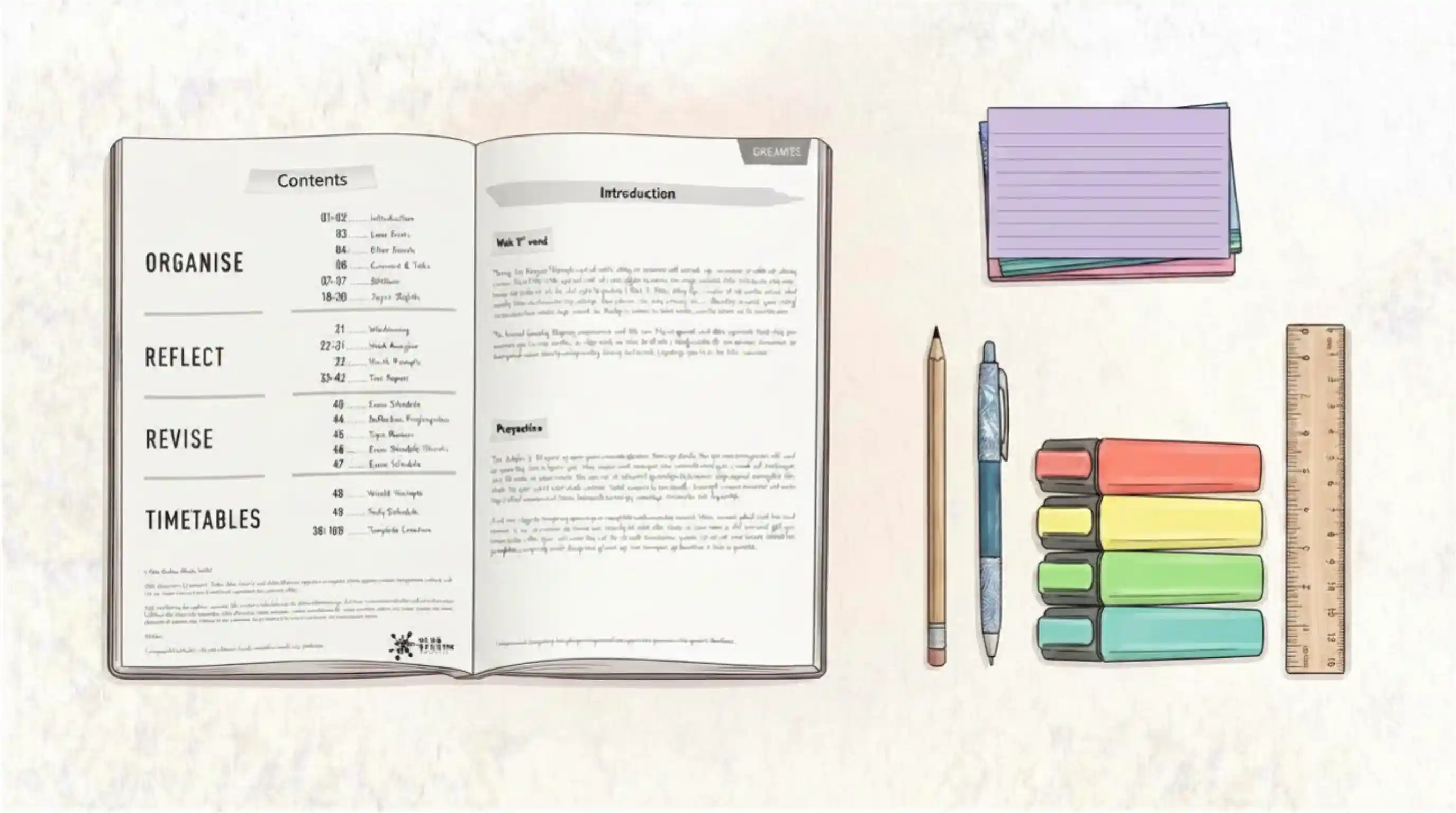
Organise: names exam anxiety directly on page one, then moves into the calendar. Twelve month-to-view pages, September through August, so exam dates, coursework deadlines and the non-negotiable stuff (birthdays, trips, prom, these are all important too) all live in one place before a single revision session is planned. A subject details table follows: exam board, number of papers, and a running list of study resources per subject, so no student has to remember where that one useful worksheet is for the third time.
- •
Reflect: where the topic audit lives, one page per subject, ten subjects' worth. Each topic gets a confidence rating and a tally mark every time it's actually revised. Watching that column fill up is its own small win. Alongside it sits mock exam analysis: target grade, mark, grade, and a two-column breakdown of what went well against what needs improving, for up to two mock attempts per paper. A mock is the closest thing to real exam conditions a student gets before the exam itself, and treating the grade alone as the feedback wastes that.
- •
Revise: the actual technique. The forgetting curve (Ebbinghaus, 1885, on how quickly new information fades without review), interleaving multiple topics in one session rather than blocking a single topic for a whole hour (Rohrer, 2012, Educational Psychology Review (opens in new tab)), and six specific retrieval practice methods, from flashcards to past papers, with a direct warning against ticking off sessions by re-reading notes.
- •
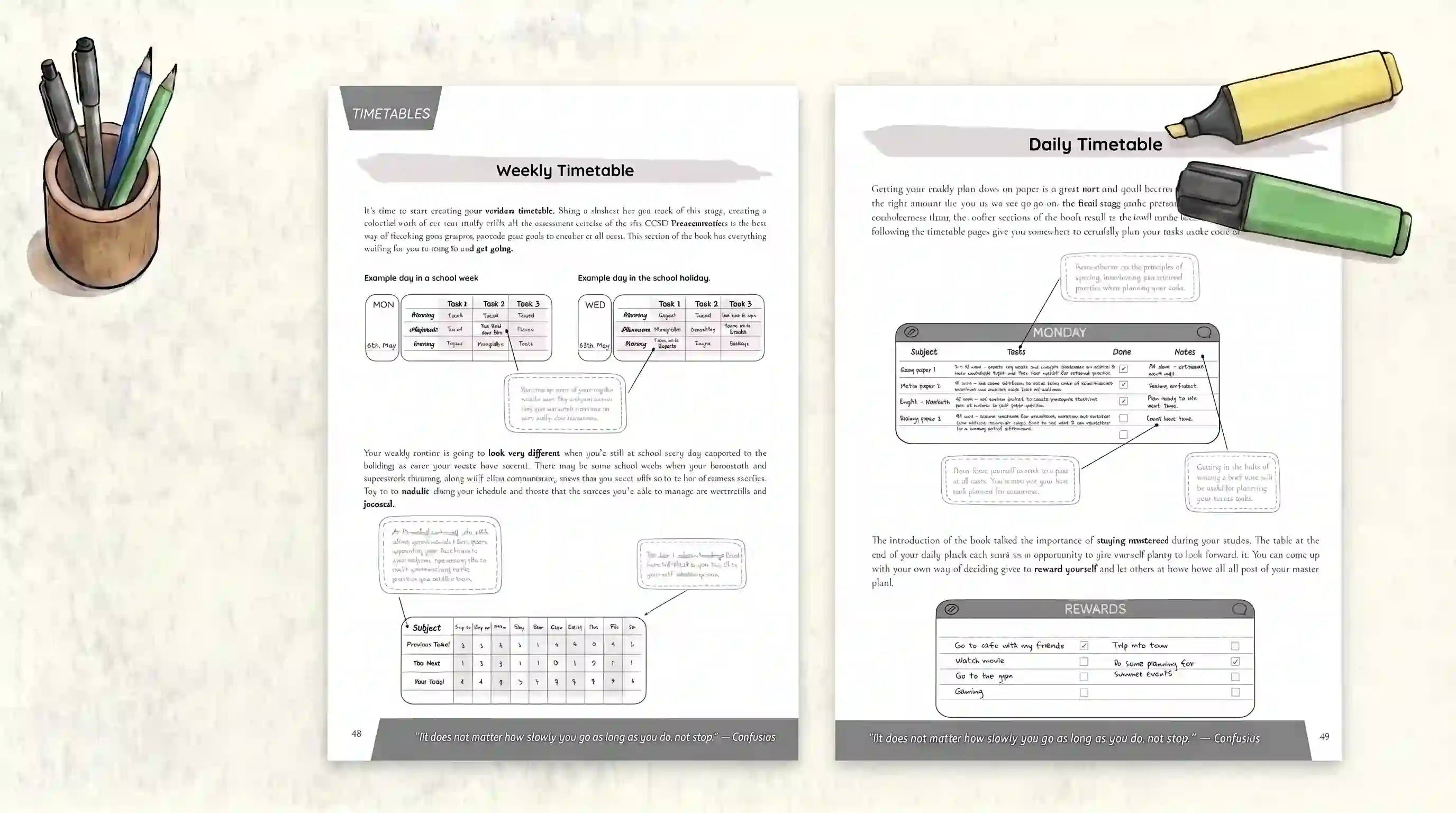
Timetables: the sixteen-week, four-month engine room. Matching weekly timetable and daily task spreads, a running subject tally so nobody quietly avoids the subject they like least, and a rewards table every single week, because revision that eats a student's whole life stops being sustainable very quickly.
Why a Physical Planner Beats an App for This
How to Actually Use It
- 1
Map the term first. Exam dates, coursework deadlines, and school holidays go onto the calendar before anything else. This gives an honest picture of how much time actually exists, not how much it feels like there is.
- 2
Audit before you schedule. Every subject, topic by topic, rated for confidence. This is the step people are most tempted to skip, and it is the one that makes every later step faster.
- 3
Plan the week before the day. This was the harder habit to build with our own daughter, and the one the book's design leans on hardest. A weekly overview first, roughly how many revision slots exist and which subjects will fill them, means that by the time a specific day arrives, there is nothing left to decide. Monday afternoon is already maths, Monday evening is already geography. The only question left is which topic, and the topic audit already has the answer.
- 4
Fill in daily tasks from the audit, not from memory. Specific topics, not just subject names. This is also where understanding what a mark scheme actually rewards helps decide which topics deserve the planner's most time, since a topic that scores well on the audit but is worth few marks is a lower priority than one that's shaky and heavily examined.
- 5
Tick sessions off as they happen. The tally marks and the weekly rewards table exist for the same reason: revision that never shows its own progress starts to feel like it isn't working, even when it is.
If the real problem is that no revision is happening at all, rather than that it's happening without structure, a planner will not fix that on its own. That's a different, harder problem, and it's worth reading our guide on what to do when your child won't revise before assuming a new planner will change anything.
When to Start
- •
Starting in Year 10: habit first, intensity second. The calendar and audit pages get filled in gradually, and the goal is simply making the planner a normal part of the week, not covering content at speed.
- •
Starting in Year 11, September to January: building coverage ahead of the exam crunch. Working steadily through the topic audit, subject by subject, well before the sixteen-week timetable block becomes the main event.
- •
Starting eight to twelve weeks out (intensive mode): the realistic marker here is the Easter holidays. Two weeks off school, then a handful of weeks before the first exam. Turning things around in that window must be a conscious decision (we have to seriously revise now, because we're close) rather than a vague intention, and it works best when it stays structured and realistic about which subjects and topics matter most, rather than trying to cover everything and actually finishing none of it.
What Makes This Planner Different
Three things set it apart from a generic timetable book. It names anxiety directly, in the title and on page one, because the anxiety is real and pretending it isn't doesn't help anyone plan better. It's built on cited research, not just the phrase "proven methods": the Education Endowment Foundation's work on metacognition (opens in new tab), Ebbinghaus on spaced repetition, Rohrer's 2012 study on interleaving. No competitor planner we've found cites its evidence the way this one does. And every page assumes a student who needs a worked example, not one who already knows how to fill in a blank grid, because our forty years of combined classroom experience has shown us that this is most effective.
Give Your Child a Revision Structure That Sticks
The Brain Reaction GCSE Revision Diary Planner: a daily planner designed to help students build a revision routine. Ideal for students who struggle to get started.
How It Compares to Other GCSE Revision Planners
How GCSE Revision Planners Compare
| Planner | Format | Anxiety framing | Cost | Best for |
|---|---|---|---|---|
| GCSE Revision Diary Planner | Physical | Named directly, built into the design | Around £13 | Students who don't know where to start and need a visible, structured home for everything |
| Pearson Revise GCSE Revision Planner | Physical | General organisation, no well-being framing | Comparable price | Students who want a well-known publisher name and a straightforward timetable |
| BBC Bitesize study planner | Digital, free | Institutional, no emotional framing | Free | Students who already have a system and just need somewhere to write it down |
| Free printable templates | Digital or print-your-own | None | Free | Students who will actually complete a blank template unprompted, which research and experience both suggest is uncommon |
| Save My Exams Study Planner / similar tools | Digital | Functional, no framing | Free or freemium | Students who want an automatically generated timetable without buying anything |
Where to Get It
The planner covers structure. It doesn't cover the hunt for the actual materials to revise from, and that hunt has its own friction: remembering which exam board applies to each of your subjects, then working through a website that wasn't built for a fast lookup. Revision Desk's directory exists specifically to remove that friction: official past papers and mark schemes for every major exam board, searchable by subject in one place, with a student's own subjects saved so every return visit is instant. The AI assistant on the same site turns any mark scheme directly into revision resources in a couple of clicks. The planner gives the structure. Revision Desk gives the content to put the theory into action.
Find Past Papers and Mark Schemes in One Place
Revision Desk's directory organises AQA, Pearson Edexcel, and Cambridge OCR past papers and mark schemes: searchable by subject, no hunting through official board websites.
Frequently Asked Questions
What is the best GCSE revision planner?
Is a physical revision planner better than an app?
How do you use a GCSE revision planner?
When should you start filling in a GCSE revision planner?
What should a GCSE revision planner include?
How many weeks does a GCSE revision planner cover?
What is the difference between a revision planner and a revision timetable?
Is the BBC Bitesize revision planner any good?
The Complete Guide to GCSE Revision for Parents
Everything parents need to know about supporting GCSE revision, from timetables to tools to mental health.