
What Is a GCSE Mark Scheme? A Parent's Guide to How Examiners Actually Award Marks
GCSE Explained

What is a GCSE mark scheme? It is the document an exam board publishes alongside every past paper, setting out exactly what an examiner must see in an answer to award each mark. It is written before the exam is sat, by the same people who wrote the questions, and it is entirely public: free to read, no login required, very little subject knowledge needed to understand what it's asking for.
Every GCSE question has already had plenty of similar variants marked many times before your child ever sees it in an exam. The examiner knows exactly what they're looking for. The mark scheme is that blueprint, written down. Students who read them revise differently, and it really helps.
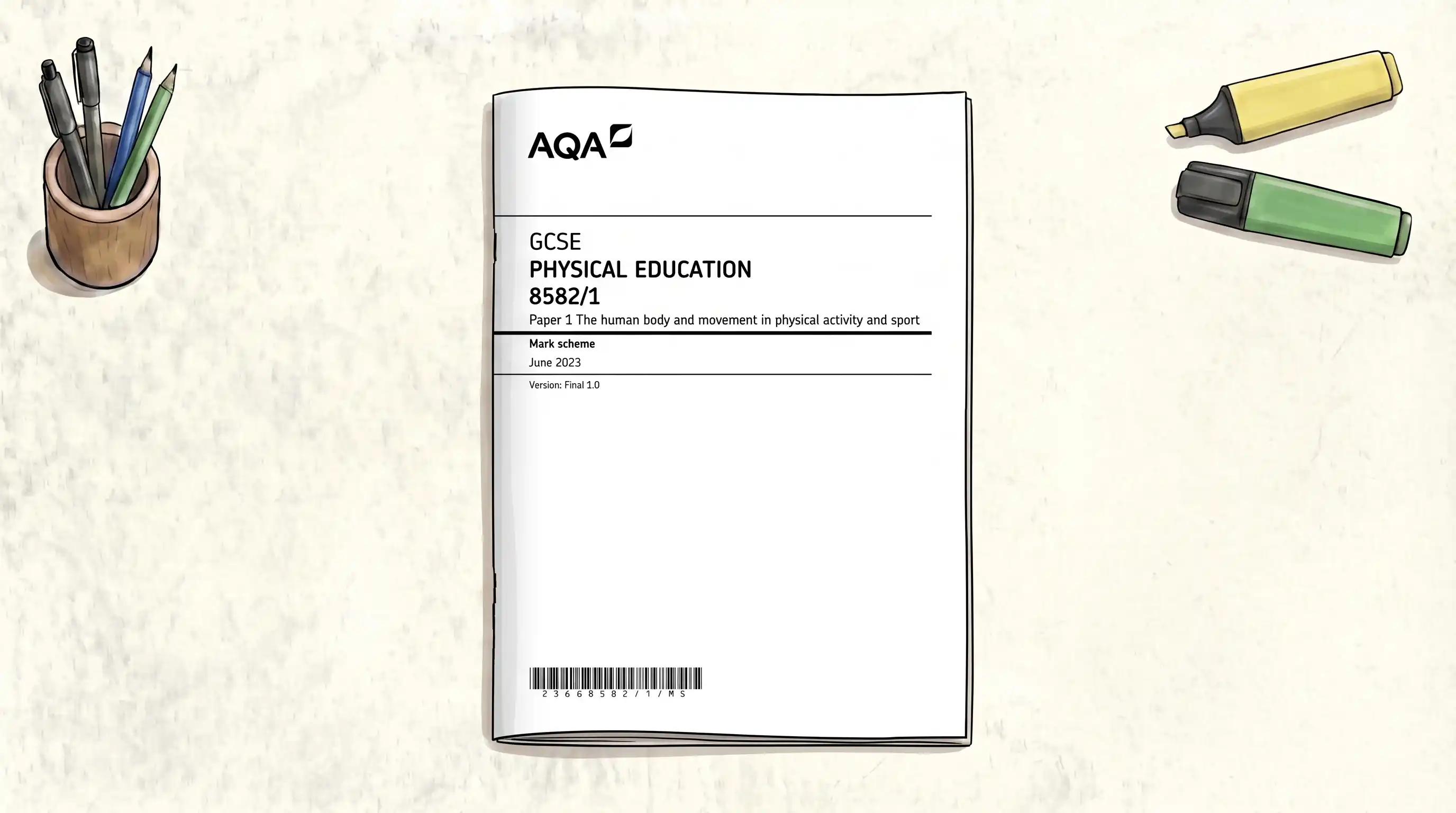
What a GCSE Mark Scheme Is
How Examiners Use Mark Schemes
Before marking begins for real, every examiner is trained on the mark scheme for their paper. They practise on sample scripts, and their early marking is checked against a standard before they're let loose on live exams. Once marking is underway, a sample of each examiner's scripts is reviewed centrally, which is how a board keeps thousands of examiners marking to the same standard across the country (gov.uk; How GCSE and A Level Marking Works (opens in new tab)).
Why Mark Schemes Matter for Revision (More Than Most People Realise)
What the Examiner Is Looking For
- •
Describe wants students to recall some facts, events or process in an accurate way.
- •
Explain wants students to make something clear, or state the reasons for something happening. A description-only answer to an explain question loses marks no matter how accurate it is.
- •
Evaluate (or "to what extent") wants a judgement, built on both sides of an argument, not just one.
An English mark scheme rewards different specific content to a Science one, but the command-word logic underneath is reasonably consistent across subjects and should be available from your child's teacher.
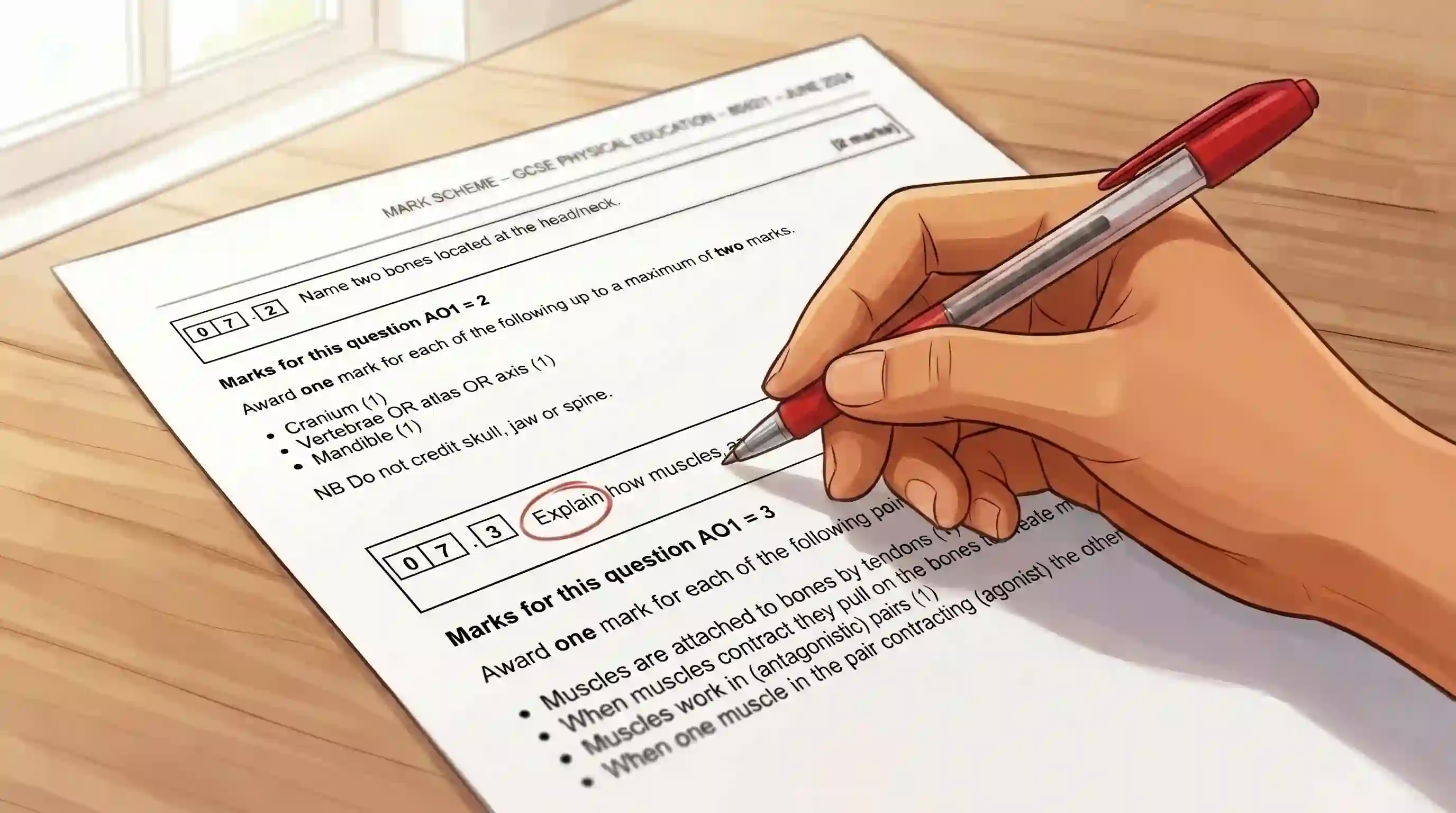
Examiner's reports go a level deeper than the mark scheme itself, and they're the most underused document the exam board releases. Published after each real exam series, they describe how students across the country actually answered each question in the exam.
Whenever a large section of my class made a similar mistake on a homework, a topic test, or a mock exam, the examiner's report for that paper was often the first place I would turn, because the same mistake usually showed up as a documented national pattern from the real sitting. It's frequently the exact command-word confusion described above: students answering too simply when a question wanted real depth, or listing several points when the question demanded genuine explanation instead.
On the hardest parts of a specification, where understanding is being really stretched, the report also lays out how the strongest national answers differed from the rest. That outside perspective from an examiner, which sits on top of the information already shared by the teacher, can produce a real lightbulb moment for a student stuck on a difficult idea.
How to Use Mark Schemes for GCSE Revision (The Parent's Coaching Guide)
The most effective way to use a mark scheme is straightforward, and it works the same way for every subject. Your child attempts a past paper question properly first, ideally under timed conditions, with the mark scheme nowhere in sight. Only once that's done do the two of you put the answer and the mark scheme side by side and work through it together, question by question.
You genuinely don't need to know the subject for this. You're not marking for correctness, your child can judge that themselves against the scheme. You're checking whether their answer has the shape the mark scheme rewards. Did a question ask for two reasons and they gave one? Did it ask them to calculate and there's no working shown? Most schemes credit the method even when the final answer is wrong, so you can see immediately that blank working has cost marks.

- •
What did the answer include that the scheme wanted?
- •
What did it miss?
- •
What did the scheme say the examiner actually needed to see?
One exercise that works surprisingly well for building this habit is from a classroom routine that I often used. Try and find an opportunity for your child to swap roles occasionally so that they are the one applying the mark scheme, not just receiving a mark. You could either attempt some questions yourself or suggest they team up with a friend who is also revising. Handing a class the scheme and having them mark each other's homework against it, coming at it from the marker's side rather than the answerer's, I found to be a good strategy to make the criteria stick. Students marking their classmates tend to be surprisingly strict once they're the one holding the checklist.
Where to Find GCSE Mark Schemes
Find Past Papers and Mark Schemes in One Place
Revision Desk's directory organises AQA, Pearson Edexcel, and Cambridge OCR past papers and mark schemes: searchable by subject, no hunting through official board websites.
The Difference Between a Mark Scheme and a Model Answer
The two get used interchangeably by students, and the mix-up causes real confusion at revision time. A mark scheme is the official criteria an examiner uses to award marks, written by the exam board itself. A model answer is an example of what a genuinely strong response looks like, sometimes published alongside the mark scheme, sometimes provided by the teachers themselves.
Use them differently. Check your child's own answer against the mark scheme to see whether it met the criteria that actually earn marks. Read a model answer separately to see what a strong response looks like written out in full, since seeing the finished shape of a good answer teaches something a checklist alone can't. The third document, the examiner's report described above, sits between the two: not a checklist and not an example answer, but a national-level account of where real students went right and wrong.
Mark Scheme vs Model Answer vs Examiner's Report
| Document | What it is | Use it to... |
|---|---|---|
| Mark scheme | The official criteria an examiner uses to award marks, written by the exam board | Check whether an answer met the criteria that earn marks |
| Model answer | An example of a strong response, published with the mark scheme or separately | See what a strong answer looks like written out in full |
| Examiner's report | A national account of how real students answered, published after each exam series | Spot the patterns behind why marks are commonly lost or won |
Getting Started
None of this requires understanding the subject, a teaching qualification, or hours of spare time. It requires knowing that the mark scheme exists, that it's free to read, and that checking one real answer against it teaches your child more about what the exam requires than another hour of rereading notes ever will. Start with one recent past paper question and its mark scheme. The GCSE Revision Diary Planner (opens in new tab) gives that kind of session an actual slot in the week, so it happens on purpose rather than getting lost between everything else.
Give Your Child a Revision Structure That Sticks
The Brain Reaction GCSE Revision Diary Planner: a daily planner designed to help students build a revision routine. Ideal for students who struggle to get started.
Frequently Asked Questions
What is a GCSE mark scheme?
How do examiners use mark schemes?
Are GCSE mark schemes available to students?
Why are mark schemes important for revision?
How do I use a mark scheme for revision?
What is the difference between a mark scheme and a model answer?
Why do students lose marks in GCSEs?
What do GCSE examiners look for in answers?
Can parents access GCSE mark schemes?
How do I help my child use mark schemes for revision?
What is an examiner's report GCSE?
The Complete Guide to GCSE Revision for Parents
Everything parents need to know about supporting GCSE revision, from timetables to tools to mental health.