Active Revision vs Passive Revision: What GCSE Parents Need to Know (And How to Tell the Difference)
tips_and_updates
Revision Strategy
calendar_today
30 Aug 2026
schedule8 min read
Written byAndy Baynton
Your child has been sitting with a textbook open for two hours. Highlighter in hand, notes everywhere, every visible sign of a revision session in progress. But has anything actually happened? The honest answer depends entirely on what's going on inside those two hours, not how long they lasted. That is the real difference between active revision GCSE students actually need and the passive kind that just feels like work. Parents who understand which is which can ask better questions, and spot a session that isn't working long before results day proves it.
What Passive Revision Is (And Why It Feels Like It's Working)
Passive revision is anything that lets your child take in information without having to produce it themselves: reading notes, re-reading a textbook chapter, watching a YouTube explainer start to finish, scrolling through Seneca or BBC Bitesize without actually answering the questions on the page.
It feels productive because it is comfortable. The material looks familiar, so the brain reads that familiarity as knowledge. Researchers call this the fluency illusion, and in my time in GCSE classrooms, I've watched it play out the same way, over and over. A student re-reading their notes is convinced they know a topic, right up until you ask them to write it down with the page turned over, and the words simply aren't there.
The research backs up what that looks like from the front of a classroom. A large, widely cited review of study techniques rated re-reading and highlighting as low-utility methods for actual learning, while testing yourself and spacing your revision out over time were rated among the most effective (Dunlosky et al., 2013, Psychological Science in the Public Interest (opens in new tab)). Recognising something on a page is a fundamentally different, weaker skill than being able to produce it from memory, and it's the second one an exam actually tests.
What Active Revision Is
Active revision forces the brain to retrieve information rather than simply process it. That single shift, retrieval instead of recognition, is the whole difference.
Cognitive psychologists draw a hard line between two kinds of memory: recognition and recall. Recognition is being shown something and judging whether it looks familiar, which is what happens every time your child rereads a page and thinks "yes, I know this." Recall is producing the same information from nothing, with no page in front of them, which is what an exam question actually demands. The two are not two strengths of the same skill. Recognition memory is reliably far stronger than recall memory for identical information, and the gap between them is large enough that it holds even for things people are confident they know well: almost anyone can recognise a coin's design the moment they see it, yet almost no one can draw it accurately from memory, get the direction the portrait faces, or say exactly where the date sits. Revision that only trains recognition leaves recall completely untested until the exam itself, which is precisely the wrong moment to discover the gap between them.
The main active techniques worth knowing:
•
Active recall, testing yourself from memory before checking your notes, in any form: a practice question, a blank page, a flashcard used properly.
•
Spaced repetition, coming back to a topic at increasing gaps rather than revising it once and moving on, so the memory has to work a little harder each time and gets stronger for it.
•
Past paper practice, the most exam-specific form of active recall there is, because it forces retrieval in the exact format the exam will use.
•
Teaching it out loud, explaining a topic as if to someone who's never heard of it, with no notes in reach.
A quick way to translate a passive habit into its active version:
Passive Habits and Their Active Alternatives
Passive habit
Active alternative
Re-reading notes
Cover the notes and write down everything remembered
Highlighting a textbook
Close the book and answer a question on what was just read
Watching a revision video
Watch it once, then explain it back with no notes
Scrolling through Seneca
Answer every question properly before moving to the next screen
Copying out definitions
Read a definition once, then write it again from memory
What Active Revision Looks Like in Practice
This is the part most revision advice skips: what should a parent actually be watching for, without needing to know the subject at all.
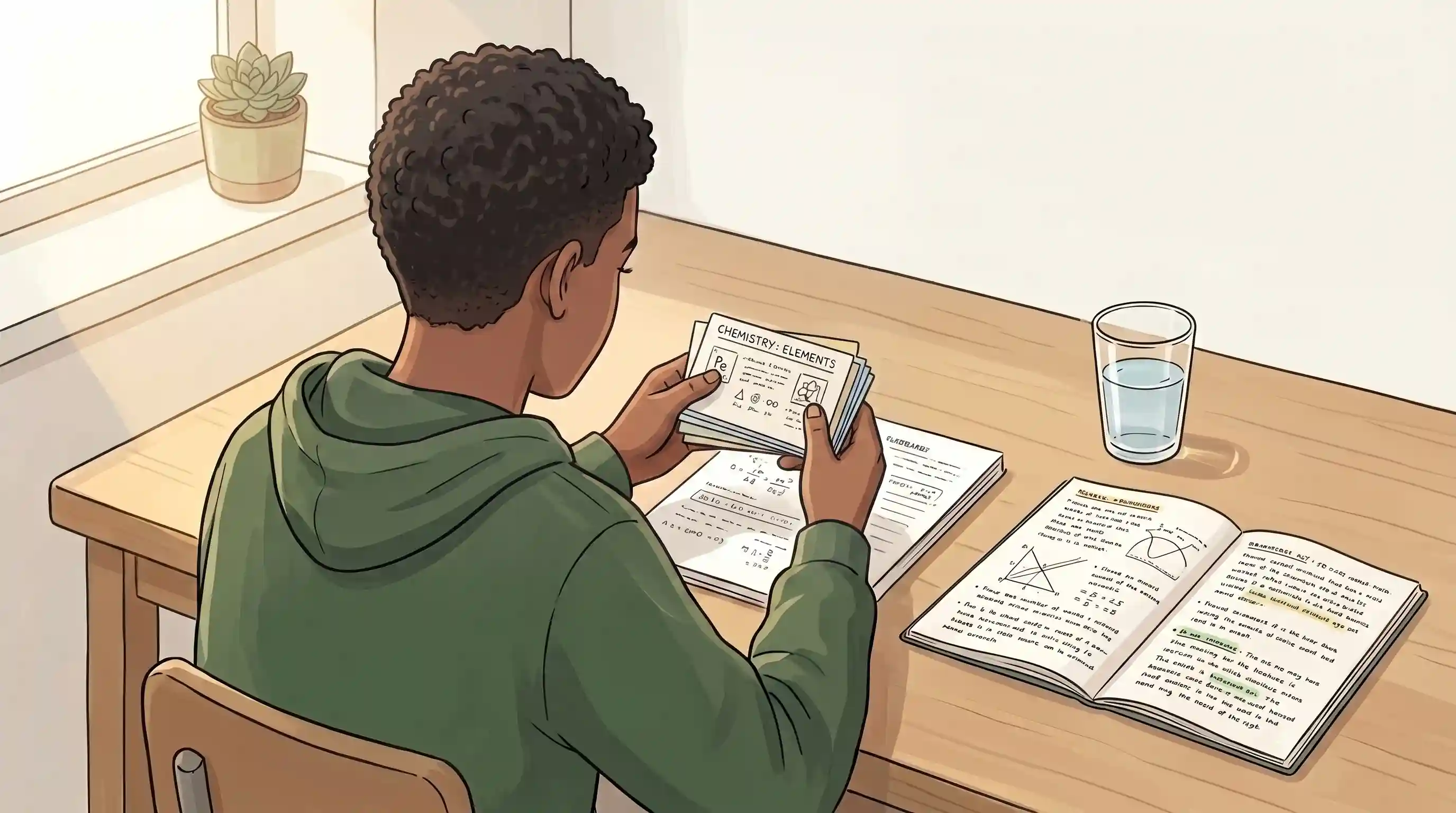
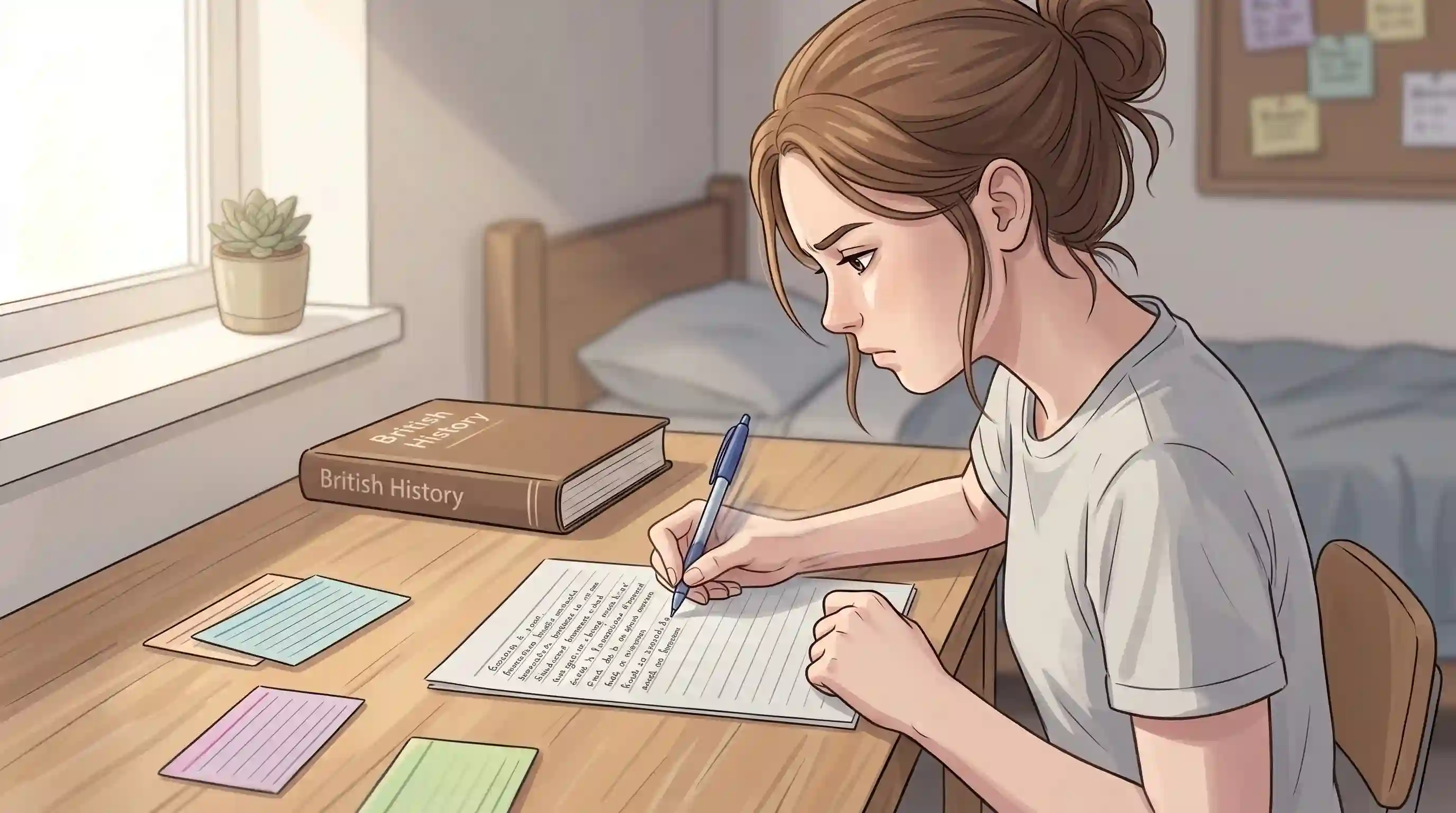
The tell isn't subtle once you know to look for it. A student doing active revision looks engaged: hunched over a blank page, muttering an answer out loud, checking a past paper against the mark scheme with a pen in hand. A student who is easily distracted, glancing around the room, or drifting off mid-sentence is giving you the opposite signal, whatever book happens to be open in front of them. It sounds almost too obvious to state, but the question that actually matters is whether they're doing something: are they creating something, working with the material in a new way, or just sitting with it.
Signs Your Child Is Doing Active Revision
•
There's a blank page they're actively writing on, not a page of notes they're reading.
•
They're testing themselves against a mark scheme, not just checking their notes are complete.
•
They're attempting past papers under some kind of time pressure.
•
They're able to explain a topic to you without looking anything up.
Signs They're Probably Not
•
Books are open, but the eyes are moving faster than any real thinking could.
•
They've been on Seneca for an hour with no test questions attempted.
•
Highlighting is happening, but nothing is being written from memory.
•
They can't tell you what they just "revised" two minutes after finishing.
The single most useful question a parent can ask, regardless of the subject: "Without looking at your notes, can you explain that to me?" It takes thirty seconds and tells you immediately whether the last hour built anything or just felt busy.
Is Seneca Active or Passive Revision?
Honestly, it depends how it's used. Seneca is built around self-testing, so in design it's an active tool. The gap opens up in how a student actually clicks through it.
Using it actively looks like: attempting each question properly, sitting with a hard one before guessing, and reviewing what was wrong. Using it passively looks like: reading through the content screens, skipping anything that looks effortful, and clicking through easy multiple-choice questions without ever really testing recall. The same applies to almost any revision platform or app. The tool doesn't decide whether revision is active or passive. The way it's used does.
The Most Effective Active Revision Techniques for GCSEs (Parent's Version)
Past papers, done under timed conditions and marked honestly against the real mark scheme, are the single most evidence-backed technique available for GCSEs specifically. They combine active recall with the exact format your child will face in the exam hall, which generic flashcards or mind maps can't fully replicate.
The friction most families hit here isn't the idea, it's finding the actual papers and marking them properly. Every exam board runs its own website, and remembering which board applies to which subject before you can even start looking is its own small barrier. Revision Desk's directory exists to remove exactly that friction: official past papers and mark schemes for every major exam board, searchable by subject in one place, with a student's own subjects saved so every return visit is instant. Its AI assistant goes a step further, turning any mark scheme dragged into it directly into practice questions and revision resources, so marking an answer against exactly what the examiner wanted takes a couple of clicks instead of a lecture from a parent about why mark schemes matter. Understanding what a mark scheme actually rewards is worth its own explanation.
Beyond past papers, a few other techniques earn their place:
•
The blurt method: write down everything you know about a topic from memory, then check what's missing against your notes.
•
Flashcards, used properly: the answer has to be attempted before it's checked, every time.
•
Teaching it out loud: explaining a topic to a parent, a sibling, or an empty room, with no notes in sight.
Find Past Papers and Mark Schemes in One Place
Revision Desk's directory organises AQA, Pearson Edexcel, and Cambridge OCR past papers and mark schemes: searchable by subject, no hunting through official board websites.
There's no single number that fits every student, but the pattern that actually holds up across a real exam year is little and often, not marathon sessions crammed into a Sunday.
From what I've seen across hundreds of GCSE students, two to three short, focused revision sessions on most days works better than one long session once a week, and it's realistic enough that most students can actually sustain it without burning out before the exams even start. Some days won't happen. That's fine, as long as the routine picks back up rather than collapsing entirely. What matters far more than the total hours logged is whether each session is doing the retrieval work described above, rather than being time spent with a book open and very little happening behind it.
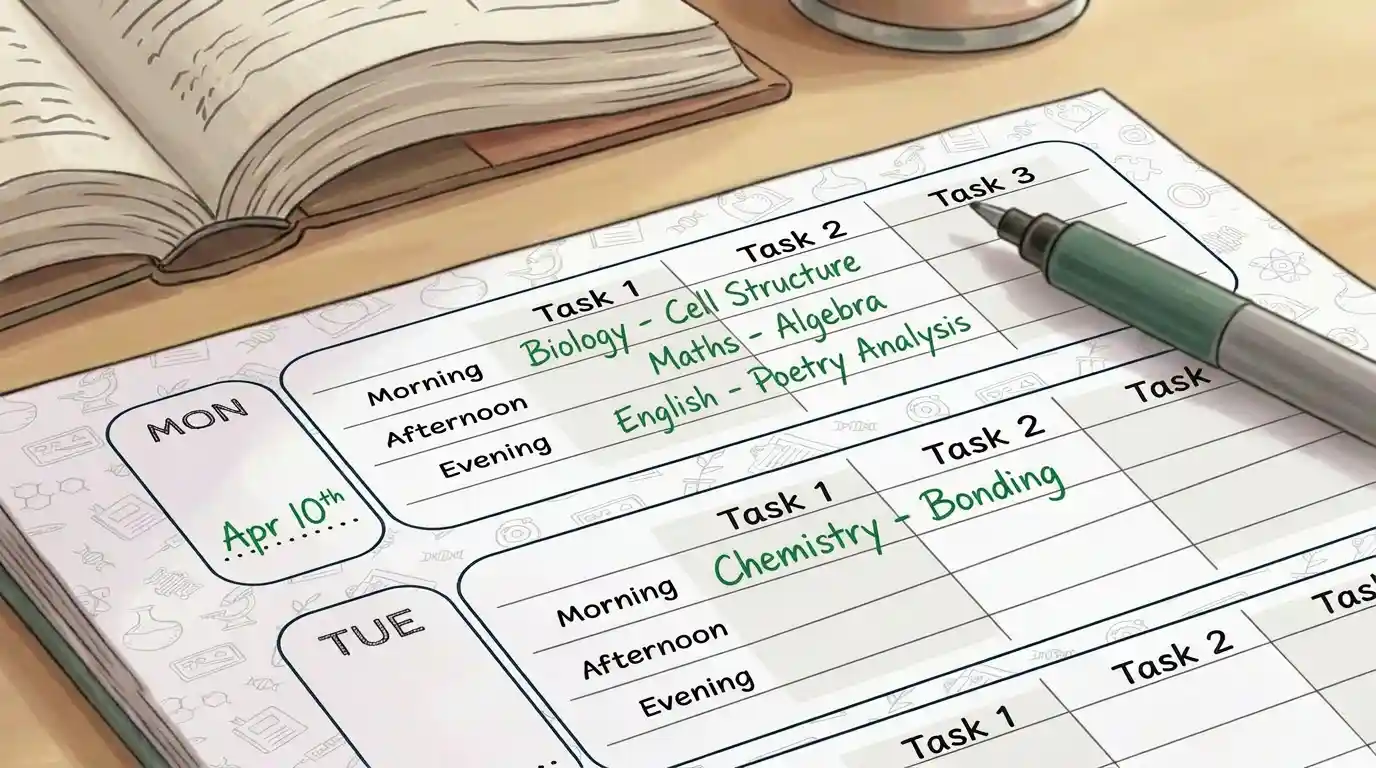
A big part of why "little and often" fails in practice isn't the theory, it's the daily decision-making. Deciding what to revise, when, eats into the time that should be spent actually revising. This is exactly the gap the GCSE Revision Diary Planner (opens in new tab) is built to close: a weekly timetable that decides which subject fills which slot in advance, so a student sits down already knowing what today's session is, rather than losing ten minutes of it deciding. It works best paired with the active techniques above, not passive re-reading, so the time it protects gets spent well.
If your child can't explain what they just revised without looking at their notes, the revision hasn't worked yet. That isn't failure. It's the most useful piece of information a revision session can produce, because it tells you exactly what still needs testing rather than another read-through. Active revision is about generating evidence that something has actually been learned, not the feeling of having sat down and worked.
Give Your Child a Revision Structure That Sticks
The Brain Reaction GCSE Revision Diary Planner: a daily planner designed to help students build a revision routine. Ideal for students who struggle to get started.
Active revision is any method that forces the brain to retrieve information from memory rather than simply look at it again. Testing yourself, doing past papers, writing an answer from scratch and checking it, or explaining a topic out loud without notes are all active. The test is simple: is your child producing something, or just taking something in?
What is the difference between active and passive revision?
Active revision makes the brain retrieve information from memory. Passive revision lets the brain simply process information that is already in front of it. Re-reading notes, highlighting, and watching a video are passive. Testing yourself, doing past papers, and explaining a topic without looking at notes are active. Only one of the two builds the kind of memory an exam actually tests.
Does active recall work for GCSEs?
Yes. Active recall, retrieving an answer from memory rather than recognising it on a page, is one of the two techniques rated highest for genuine learning gains across large reviews of study research (Dunlosky et al., 2013). It works for GCSE content the same way it works for any subject: the effort of retrieval is what strengthens the memory.
What is the best revision method for GCSEs?
Past papers marked honestly against the real mark scheme, under timed conditions, is the single most evidence-backed method for GCSEs. It combines active recall with exam-specific practice: your child has to produce an answer from memory, then find out exactly where it fell short of what the examiner wanted.
Is re-reading notes effective for GCSEs?
Not on its own. Large reviews of study techniques consistently rate re-reading and highlighting as low-utility methods (Dunlosky et al., 2013), because they create familiarity with the material rather than the ability to produce it from memory. Re-reading has a place as a first pass before testing, but it should never be the whole session.
Is Seneca Learning active or passive revision?
It depends entirely on how it's used. Seneca is built around self-testing, which is active in design. But a student can still use it passively, reading the content screens and skipping straight to the easiest questions without genuinely attempting the harder ones. The platform doesn't decide which; the way your child clicks through it does.
How do I know if my child's revision is working?
Ask them to explain a topic to you without looking at their notes. If they can do it in their own words, the revision has worked. If they can't, that's useful information, not failure, and it tells you exactly what still needs active practice rather than another read-through.
What does active revision look like in practice?
It looks like effort, not comfort: a blank page being written on, a past paper being attempted before the mark scheme is checked, a topic explained out loud with no notes in reach. It rarely looks calm. A student doing it well often looks more like they're struggling than a student quietly re-reading a page.
What is spaced repetition for GCSEs?
Spaced repetition means returning to the same topic at increasing gaps, rather than revising it once and moving on. A topic covered this week gets tested again next week, then again in a month. Each successful retrieval after a gap builds a stronger, longer-lasting memory than repeating the same content on the same day ever could.
How many hours of active revision should a GCSE student do?
There's no single correct number, but two to three short, focused sessions most days consistently works better than one long session a week. Little and often beats marathon revising, both for what actually gets remembered and for what a student can realistically sustain across a whole exam year without burning out.
Why does my child study for hours but still fail exams?
Almost always because the hours were passive. Re-reading and highlighting create a feeling of familiarity that gets mistaken for knowledge, right up until an exam question asks for that knowledge to be produced from memory, with nothing to prompt it. Time spent and learning achieved are two different things, and only active methods reliably close the gap.
The Complete Guide to GCSE Revision for Parents
Everything parents need to know about supporting GCSE revision, from timetables to tools to mental health.